

Owning a large parrot requires a massive lifestyle shift that goes way beyond standard dog or cat care. It’s a lifetime commitment that completely reshapes your daily routine, especially since these birds can live for 50 to 70 years.
If you are trying to decide between Cockatoos and Macaws, the choice comes down to one fundamental difference.
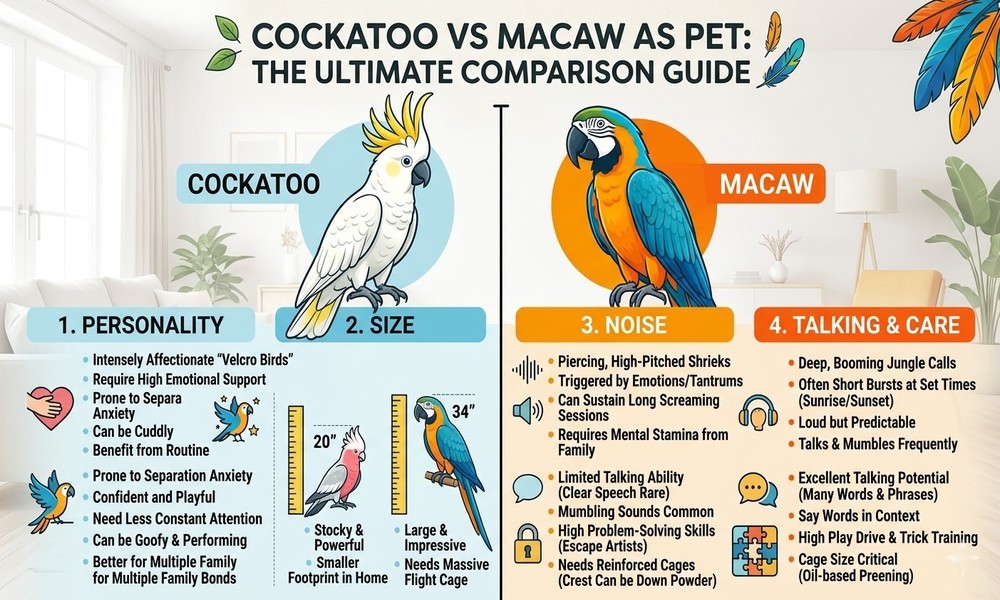
Macaws are independent, outgoing entertainers that fit well into active families. Cockatoos are intensely affectionate “Velcro birds” that require constant emotional support from a dedicated owner.
Choosing the wrong one based purely on looks is the fastest way to end up with severe behavior issues, screaming fits, and neighborhood noise complaints.
Here is the honest, day-to-day reality of living with a Cockatoo vs Macaw, broken down by household space, noise levels, and real-world temperament.
Home Environment: The Powder vs. Oil Factor
Before worrying about behavior, you need to consider how these birds physically impact your home’s air quality.
Macaws are native to South American rainforests. They are famous for their massive, bright feathers and long tails. Because they use an oil gland at the base of their tail to groom themselves, they don’t create airborne dust. This makes them a much cleaner, safer option if anyone in your house has allergies.
Cockatoos come from Australia and are famous for their dramatic head crests. But as household pets, they come with a major catch: feather dust. Cockatoos are “powder down” birds. They naturally produce a fine, white powder to keep their feathers clean.
In a closed home, this powder coats your furniture and floats through the air. It can easily trigger asthma or severe respiratory allergies.
Cockatoo vs Macaw Size & Physical Space Comparison
The size of your bird dictates the size of your life for the next few decades. You can’t just buy a standard cage from a local pet shop and expect a massive parrot to be healthy or happy inside it.
The physical footprint these birds take up depends entirely on the specific species you bring home. Let’s look at the actual space you need to clear out in your living room.
Macaw Size Realities
- The Giants (Hyacinth, Green-winged, Blue & Gold): These species are staggeringly massive birds. They measure anywhere from 33 to 40 inches from head to tail, with a wingspan that easily hits 4 feet. To keep their gorgeous tail feathers from bending and shredding against the bars, you need a cage that is at least 48 inches wide, 36 inches deep, and 60 inches tall. Before committing to one of these giants, you really need to map out your living room layout. If you want to check out pricing, real photos and sizing for these species, browsing active Macaw birds for sale listings is a great way to see their true scale before buying. If you want to explore the full variety of these birds, reading up on all types of Macaw species will give you a complete breakdown of their sizes and colors.
- The Mini-Macaws (Hahn’s, Severe): If you live in a smaller home, these are a lifesaver. They stay between 12 and 20 inches total. You still get the big, goofy Macaw personality, but they fit comfortably in a standard large bird cage without taking over your entire room.
Cockatoo Size Realities
- The Giants (Moluccan, Umbrella): These are stocky, heavy-bodied birds that measure between 20 and 24 inches. They might look shorter than a large Macaw on paper, but they are pure muscle. Because their crushing beak power is off the charts, you can’t use a standard wire enclosure. They require heavy-duty cages with extra-thick bars, or they will literally snap the welds and chew their way out.
- The Smaller Species (Galah, Goffin’s): If you don’t have space for a massive flight cage, these smaller types stay around 12 to 15 inches. They are compact, high-energy packages that fit much better into standard rooms without requiring you to remodel your home layout.
Cockatoos and Macaws as Pets: Personality Realities
The absolute biggest dealbreaker when choosing between these two families as pets is their emotional personality. You have to ask yourself how much attention you can realistically give a pet every single day.
When evaluating a macaw vs cockatoo personality, the core distinction is clear: Macaws are mostly motivated by entertainment, play, and mental games. Cockatoos, on the other hand, are driven almost entirely by their need for emotional security.
The Cockatoo: The Ultimate Emotional Investment
Cockatoos are called “Velcro birds” for a reason. They don’t just want to be in the same room as you; they want to be physically stuck to you. They crave deep affection and will happily snuggle under your chin or hang out on your shoulder for hours.
While a super cuddly pet sounds amazing, this level of dependency is a massive time commitment. Cockatoos are emotionally fragile.
If they feel ignored for even half a day, they get stressed out quickly. This stress usually triggers severe behavior issues, like non-stop screaming fits or plucking out their own feathers. They really need an owner who works from home or has a very predictable daily routine.
The Macaw: The Outgoing Independent
Macaws are more like the party animals of the parrot world. They are confident, outgoing, and total show-offs. They love performing tricks, hanging upside down, and being the center of attention without needing you to hold them constantly.
A pet Macaw is perfectly happy hanging out on a play stand, staying busy destroying a wooden block while watching the family from across the room.
If you have a busy workday, a Macaw with a cage full of chew toys can easily keep themselves entertained. They are also much better at bonding with the whole family, whereas a Cockatoo tends to fixate on just one person and reject everyone else.
Noise & Vocalization Comparison
Let’s be completely honest: both of these birds are incredibly loud. However, looking at the nuances of cockatoo vs macaw noise, the type of noise they make and how often they make it will dictate what kind of home you need. Neither bird is going to work if you live in an apartment or have neighbors sharing a wall.
- The Macaw Vocal Style: Macaws have a deep, booming jungle call that sounds like a loud, harsh honk. It easily carries for blocks, but they usually scream in short bursts rather than non-stop. They typically blast your ears for 5 to 10 minutes at sunrise and sunset when they wake up and wind down, or whenever a guest walks through the front door. The rest of the day is mostly spent talking, mumbling, or playing quietly with their toys.
- The Cockatoo Vocal Style: Cockatoos have a piercing, high-pitched shriek that can literally make your ears ring if you’re in the same room. Because they are so emotionally sensitive, their screaming is completely tied to how they are feeling. If they get anxious, throw a tantrum, or even see you walk out of the living room to go to the kitchen, they can easily scream for hours on end. Living with a Cockatoo requires serious mental stamina and a family that doesn’t mind a chaotic, loud household.
Training, Mechanical Intelligence, and Talking Ability
If you really want a bird that can actually talk, the Macaw is the clear winner here. They don’t mimic voices quite as perfectly as an African Grey, but they can easily pick up dozens of words, phrases, and songs, and they usually say them at the exact right moments.
If speech is your top priority, learning how to choose perfect talking parrots will help you evaluate a bird’s true vocal potential before making a decision.
Cockatoos, on the other hand, can’t speak clearly. They usually just make these bizarre, hilarious mumbling sounds instead.
But when analyzing overall cockatoo vs macaw intelligence, what cockatoos lack in talking, they make up for in pure puzzle-solving smarts. Cockatoos are the ultimate escape artists. They love trick training and figuring out how things work. They can easily undo cage latches, open locks, dance on beat, and play interactive games with you. Thanks to their sheer problem-solving skills, you’ll need a heavy-duty setup with proper locks-otherwise, they’ll master an escape act before you even leave the room.
Summary: Which Pet Fits Your Lifestyle?
| Household Dynamic | Choose a Macaw if… | Choose a Cockatoo if… |
|---|---|---|
| Daily Schedule | Busy with daily home tasks, but can commit to set daily play blocks. | You work from home and want a constant lap companion. |
| Family Setup | You want a bird that interacts with multiple family members. | It is a one- or two-person quiet household. |
| Allergy Tolerance | Someone in the home has mild dust allergies. | No one in the home has respiratory sensitivities. |
| Noise Tolerance | You can roll with loud, deep jungle calls at set hours during the day. | You can handle ongoing, high-pitched attention shrieks. |
Making Your Final Decision
Ultimately, your final choice between a Cockatoo and Macaw rests on an honest assessment of your living space and the hours you can dedicate to them daily.
If you want a playful, dramatic, and incredibly smart companion that fits right into the family dynamic without needing constant emotional management, a Macaw is an excellent fit. On the other hand, if you have a quiet home, work from a home office, and want an intensely loyal companion that lives for cuddles and deep physical connection, a Cockatoo might be your perfect match.
Whichever path you choose, finding a reputable, ethical platform is the most critical step to ensuring a healthy, well-socialized pet. If you are leaning toward the cuddle-bug personality, looking into a verified Cockatoo for sale listing is a safe bet for finding healthy, hand-reared birds raised by professionals who understand their delicate emotional needs. Using trusted specialized platforms like CAExoticssBirds ensures proper lineage tracking, essential resources, and the species-specific guidance your new companion needs to get the best possible start in their forever home.
Prepare your living space, respect their intelligence, and get ready for an unforgettable lifetime adventure.